

A Little Fantasy
Excerpt from A Thousand Knights, A Thousand Boons

Aboard the Castellan’s Wager, en route to the Strait of Cassandra
Travel Log: Aquina Dervoe
15th Long Candle, Spring, 20th Year
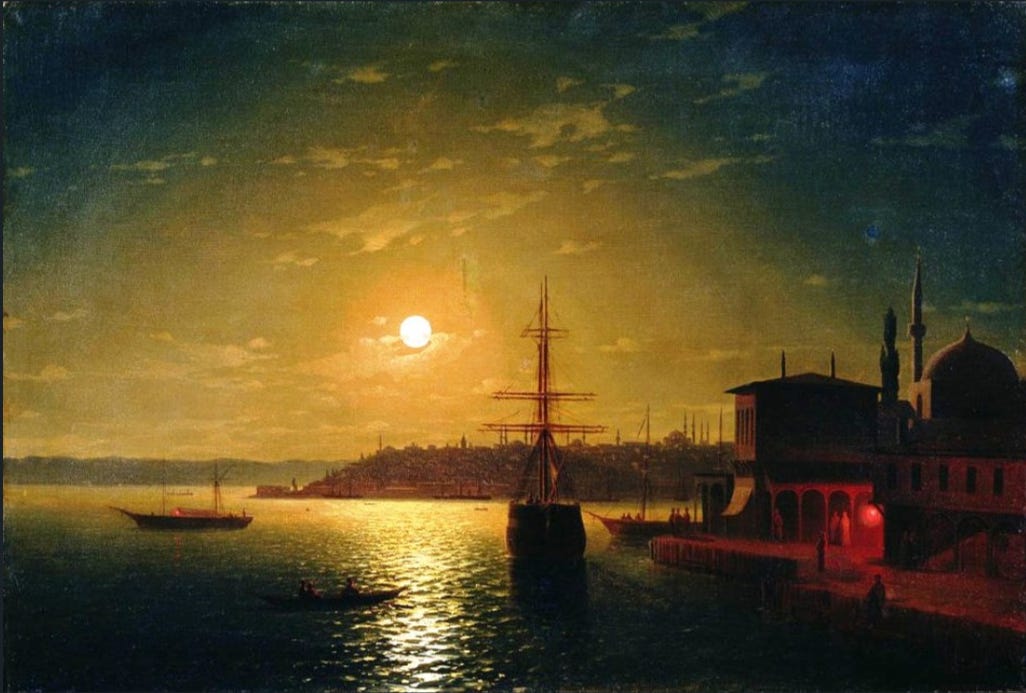
I shall never forget today. Twenty years of life, none of it wasted, and all of it less in the face of the fullness I have seen. A person cannot know all that is unknown to them: Father has said it many times. Too, too many times. And today -I should say tonight- under the moon beams striping the midnight waters of the Cassandra Strait did I hear a voice sublime.
I am going too quickly. But for fear of losing any singular detail of all that was said, all that was seen. And what was felt!
Today, journal, what it birthed! And now tonight, what opportunity awaits! But I cannot get ahead. I have to record it from the beginning of my approach to the Wager while traveling through the market. At first I was, like any new traveler, astonished by the chime of the harbor shipping bells and the cries of callers proudly bellowing their “All aboard.” Hulls knocked against wooden wharfs like an unsteady percussion over the pleading of seabirds hovering like so many white paper kites above open food stalls, their wares picked over by travelers haggling with smiling merchants dripping in colored silks. The music of Soursel’s harbor threw the arms of it sound around me and for a moment I was swept up in the grandeur of it. Pulled into its power. Shocked by the flippant ease of a traveling tailor who, without a breath’s worth of pause, so quickly traded fistfuls of golden coins for a crate of cloth. And he just gave it away, as if it were nothing. This seemingly meaningless decision for a greater amount of money than I have ever seen in my whole life. And I witnessed it over and over and over. Apprentices buying bundles of coal for their masters. A laughing smith giving over a sapphire the size of a walnut for ten ingots of silver. Three squires part of a retinue, all of them awestruck, each reverently thanking their Lord at the purchase of the armor that now identified the changing of their station in life.
I now understand what father meant when he said, “There is trade, Aquina. And there is economy. The are each like the wind. Trade, the breeze. Economy, the hurricane.”
And the harbor market was more than just its exchange of sound and money. But the teeming life. The color of vendors’ fruits. The shine in their silks. But also all of the occupancy of the people in that place in that moment. All of us rubbing shoulders, fingers sliding over hands of those whose names and faces I shall never know. Life piled on life. And it is strange to think that in this intimate proximity of hundreds of people, I have never felt more a foreigner to humanity. And I remember slipping my fingers into the long emptiness of my pocket, for some reason, thinking that gripping my boarding pass would somehow settle me in the rightness of my direction. Reassure me that I was not lost among the crowd. That I was headed in the right direction. I needed the authority vested in that official document, the comfort found in its thin sheets, because I felt so far away from home and so vulnerable to the world and so at the mercy of the strangers.
And then, suddenly, the rows of merchant tents ended and the press of people sprayed out unto the widening width of the wharf, and there was…the ocean. A volume of rippling color reaching and reaching, long reaching into a horizon line the pastureland grasses of home could on their most brilliant expanse of flatness likely never equal, certainly never surpass.
I fell, a willing victim to the vast openness of the deep green of the Pulain Sea. All the shackles of civilization behind me, all the untrammeled waters ahead. The seeing of that sight poured into me a fathoms-deep ache, a longing to see all the sights that might be seen. Make myself a witness to all the wild beauty of a world I had never known. And then, strangely, I loosed my grip on the leaflets composing the boarding pass, for I worried that I might wrinkle it too much or crack the merchant seal I knew would be checked by the Wager’s first-mate.
I will admit, only here, and possibly one day to the person I will choose to share the secrets of my life with, that I ran down the length of the wharf. I ran, like an idiot, thinking that I might be late or that the ship would leave without me had all the other passengers arrived before me. I now know that was a silly thought, as the first-mate assured me in a very dismissive tone, “That is not how passage travel works.” His name is Stellan and he is a balding man, built like a barrel. His is a mean smile, which shows up far too often as he constantly smokes a pungent tobacco that has stained his teeth. I do not like him, though the rest of the crew seems nice enough, and they are quick to obey his command.
The sails of the Wager caught the river of wind that comes rushing from the high-peaked mountain valley. The gale, snow cold and undeniable as fate, poured itself into every linen sheet stretching stern to bow. So great was the power of that wind, mighty the speed gave to the Wager, that I near lost my footing. I looked up, awestruck. How the sails billowed. How the sailors happily howled at the sound of the mountain-funneled wind filling the mechanism of traversal many of them have used since the time they were ship-children. Each scurrying mate, dressed in the native colors and fashions of their various homelands moved about the vessel as one pure body of action. I noticed that on their arms, every one, were striped by a single white wrap of linen sailcloth. Curious, I asked Stellan what the marker meant. And after calling to pair women crawling the rigging from topgallant to skysail, he explained the cloth wraps. This was the communal band of every Wager marine, each strip cut from a sail of the ship they employed; many strips, one cloth. “The wind is the breath of the world,” he said, pulling his pipe from his mouth. Then he smiled, his teeth near green as the eternity of sea behind him. “The sails are the instrument catching that breath, and our sailors,” and he paused. His smile not so mean as he looked from sky to me. “Our sailors are musicians of navigation, Ms. Dervoe. And those who crew with the Wager wear the white of her color with a pride no cushion-sitting monarch could ever know.”
It was a marvel to watch them work. Communicate commands while others sang a tune whose words I cannot remember, but found myself humming later in the day. For all the differences life had set upon them, once each individual had been knotted into that sailcloth collective it changed them. All their identity, all their mutual trust, all their fellowship vested in that simple band.
The Sorusel market within the white, twisting stone streets winding their way through the red stone city, began to shrink. A blue albatross, chased by a trio of horned gulls, stretched his wings to catch the mountain wind, lifting high, so high that the small troubles pursuing him could not reach the apogee of his rise. The gulls soon turned back, whether they were successful in chasing off the albatross or failures in some other purpose, I did not know. I do know that I felt a connection with the apex-seeking albatross. I watched him for a long time, even when he cut across the face of the sun, where all his brilliant blue turned to black. I thought, “We are not so different, you and I.”
It made me think of mean Marion and all her mean friends following me home day after day, with their cruel jokes and snide comments. They, like the gulls, had soared as far as their little wings could carry them, and I had found the reach of the sea. Because of the love of my parents, my wingspan was greater than theirs, and I would fly further than they could ever dream.
Where they would subsist in life, I would achieve.
After a while, the albatross tilted, peeling away to find wherever it is only grand creatures might roam.
And so, with a week or more of sailing ahead of me, I made my way down a short flight of stairs into the dark, narrow vascularity of the heart of the ship. All the weathered wood of the top deck was replaced by witchwood walls and cross-sections, the white grain within the wood shining brilliantly as veins of silver in the lamp light. From above a bell chimed four times, then soon after a voice calling hands to deck. A portion of crew sprang up from a lower deck, moving with purpose. Upon seeing me, the sailors turned their shoulders to let me pass by, each one giving a knuckled salute of acknowledgement before climbing the steps to hurry about their work.
I found numbers on cabin doors and had to turn back once after finding I had missed mine. Opening the door for the first time, seeing all the sunlight pouring in through the port window and feeling all the speed of the ship skimming swiftly upon the face of the ocean…I must admit, I became emotional. All at once I felt both overwhelmed…and also silly for having my heart spill over so quickly at such a simple sight. Now, considering that moment, I think it was the simpleness of the room, the uncomplicated sensations which resonated within me so deeply. I was the daughter of a farmer and a seamstress, on my way to the Beltainian coast, where I would seek out the life of a playwright. Learn from the great Soren Moran, who had shaped the culture of a nation in the deep-cutting humor of his satires. Shattered the hard, royal hearts of monarchs the world over with star-crossed romances burning so hot, so bright that they sundered to ash the hearth of the world and the firewalls of time.
Oh how it would feel to be able to achieve that effect. To learn the secret pathway which leads uninterrupted from the eye to the heart. To not only learn, but to practice the sacred art of fiction, that realm where one person may live the life of a thousand others, and experience the transformative moment of what it means to discover fire for a second time.
Entering. Shutting the door. I rested my shoulders against its sturdiness. Closed my eyes. I was here. On my way. And the sensation was so powerful that I tossed my luggage upon the bed and took my seat at the writing desk, which was a little too tall, but a swiftly-placed pillow in the chair mostly solved that problem. I drew my pen and ink and leaves from my pack. Knowing the strength of this feeling in the cyclone of that moment, I began to do that which I had done since I could remember remembering. I began to write. When I am in those moments I have to force my hand to steady itself, slow, to ensure that all that work will not be wasted later for lack of legibility. I began work on this travelogue, writing it for my parents, so that when I returned home from my three-year stint in East Vale they would be able to experience every fortune their labor had bought their daughter. That they might feel and know and sense my own gratitude, my astonishments, even my hardships. I know those will come in a form greater than a desk a little too tall.
I dove deeply into the wellspring of creativity, letting the source of me flood onto the pages. And then, something strange happened. After spilling out in such a rush channeled by the market, the ship, and the white-banded crew of the Wager, I became sad. I had written for hours, feeling elated about all I had shared upon page after page after page. All of it feeling as right of angle and true of shape as any one person can feel about the architecture in the heat of draft. And needing fresh air, I returned to the top deck where I found only a few crew milling about. I looked out beyond the bow of the ship and found only the overwhelming reach of the ocean.
Where my whole life I had only known the rolling hills carpeted in the green of spring and the umber cart roads so clearly leading toward distances I could understand, all of it replaced with the empty blue of sky and the stretch of self-same waters. So alike were they in their color that they melted into one feature of unknowable distance. Instinct took me and I turned to the stern, hoping to still see even the faintest diorama of Soursel. But there was nothing but more sky, more ocean. Home was beyond eye-shot, which I have known. But now, it was beyond my capacity to reach. And it announced in me such a feeling of helplessness. Aloneness. And I began to ache to hear my father’s voice, singing in the field. To once again feel my mother’s hand graze against mine as we shelled beans from the same bowl.
The mighty wind stream ushering the Wager toward a foreign elsewhere, and me away from all I have ever known, brushed fresh tears through my lashes. My emotions already at their height, I stood on upon the prow of the deck wiping my cheeks, desperately trying to be as strong and irrefutable as the ocean wind. After all, it was not as if I could go to the Captain and say, “No, please. I did not know it would feel this way. I have made a mistake.” Such a thing would present me as too hysterical or too young to be taken seriously by the world around me. Or worse, too weak to strive toward my playwright dream. And that, I would not allow. So, I swallowed that sorrow, all that childish longing, and told myself it was good to feel this feeling. For I would one day give its authenticity to a character, and whether it be protagonist or antagonist, that fiction would break the hearts of audience and reader alike.
That is all fiction is, I realized. All theater work and literature and balladeering is the composition our aching hearts robed in the glory of imagination. And then, upon the dawn-break of that personal epiphany, there came another.
Through the web of rigging and over the low roar of the sailing wind, from the portside prow, my ear caught a voice unlike any which I had heard that morning from the shanty singing crew. Those voices had been bawdy, gruff, their power found in the collective rhythm. This voice was singular; clear, bright, high as the afternoon sun. Talented and practiced, it pierced the air. Pierced me. A tenor, singing the opening bars to All Our Hearts One, the funeral song so many mothers and fathers, siblings and cousins knew in the time of the old wars, still now passed down. Drawn toward his sound and its soothing effect, I made my away around fastened cargo, striving to see the song’s origin.
It was a young man, dressed finely, the black waves of his hair rippling like the waters upon which we traversed. His hands were in his pockets, his instrument facing the openness of the sea. For as long as I live, I will never forget the portrait of the man. Tall and reed-thin, like a blade sheathed in a cloth scabbard of navy and white. Pulled forward by the purity of his sound, I approached. And that music reached down into the fathoms deep place my homesick heart had fallen and drew it up and up, to the high place only the kingly, blue albatross can know.
And then it happened…like it always does, my vision was focused on the object ahead, and not the place where my feet where. Needless to say, a coil of rope snagged my step, and I fell into a stack of crates. A low, ugly bellow fell out of me, following me all the way down to the deck. The young man stopped his singing, startled by what I can only fully describe as a stupid, cow-like bellow. Though less stupid than my hands became, for as I tried to catch my weight, my fingers slid upon the sea-soaked deck and I plunged forward. My hair tangled about my face, my limbs snaking through guylines, his first vision of me must have been that of a gorgon, sopping wet from blouse to pants.
“Ma’am,” he said, coming to me in a rush of help. “Ma’am are you quite–
“I’m fine,” I replied, trying to laugh it all away as girlish silliness. “No really, please, don’t–
Oh, journal. He reached. We touched. His hands smooth and strong as ivory, drew me up and cleared away all the tangles of that rope.
His eyes were blue. The deep blue of the distant moon. His slight overbite peeped through his lips, then stretched to reveal a smile I think more young women than not have given to the lovers in their dreams. “Are you sure? Did you fall hard?”
The word, “Yes,” was all I could say, having so much more meaning than he could know.
“You have a,” he began and shuffled his shoulders a bit before he reached forward and produced a thread of shipping rope from my hair. “There we are now. No one will ever know it happened, I mean, aside from half the ocean on you.”
I blushed, smiled, and jokingly hid my face in my hands.
He laughed, a different kind of music, but music all the same. Light and hearty, nothing to hide in the high pitch of its sound. “No, no.”
“It may seem a lie, but I have been known to be quite graceful,” I said, shaking my head and still trying to shelter my embarrassment in a wayward look to the sea. “I heard you singing and I thought it was–
“Oh, well, then we are even,” he said.
I looked back at him, curling my hair behind my ear.
“I was practicing for a..a…” and he paused, as if lost for a moment. “What’s your name?”
“Aquina Dervoe.”
“Aquina.” The word sounded strange on his lips, new to him.
“Yes?”
“Where does a name like that call home? Where,” he asked again, and again the searching pause. “Did you come from?”
“Tammerlain,” saying the name of the greater land, and not High Field Down, where my father’s plot was specifically vested.
“That’s a big place for such a small name,” he said.
“You know it?”
“I know of it, though I have never been. My patron has made sure that I have a good grip on the geography of all the realm. From your complexion I would have guessed there or Sorusel, somewhere along the brow of the world.”
A moment passed. “So, that’s me…”
“Oh. How impolite of me. I am Jacob Mason,” he said, straightening himself. He gave a nod, small yet formal. “I come by way of the Black Rock, spending most of my life in the capital, though I have traveled more than my fair share south, thanks to the requirements of my patron, Sir Dr. Thomas Ungar.”
He said this name as if it should have drawn astonishment out me and when it failed to do so, he stooped his head, waiting for me to realize something I must have missed. “Thomas Ungar,” he said again. And again, this time slower, “Sir Doctor Thomas Ungar of Steamwell. Gentleman of the Imperial Road? Survivor of the Hungry Ford.”
I slowly shook my head. “I…?”
“Royal Inquisitor to Lady Persimone of Albrecht? The Solution Merchant.”
“I’m sorry,” I said. All these titles, pile upon pile of honorifics, all of them spilling out of his mouth like the wealth of coins falling from the hands of buyers into the purses of Sorusel merchants. Each one heavier, more grand than the last, making me feel…somehow out of my depth. Ignorant of a world I had not yet had an opportunity to cherish.
“Oh my,” he said, drawing himself back. I was certain he would throw pity on me now, for trying to connect with a braying, clumsy idiot from an ignoble acreage never worth a note in a song or mention in the most base tale. “What an idiot you must think of me.”
“What?” I said. “No.”
“Here I am, blathering on about one man, who I admit has been unimpeachably kind and important to me for the whole sum of my life, and you said nothing when I had not even heard the name of the whole town where you are from. Sea and the stones within them, I am as dense as the mast of this ship.” The apology, so abrupt, so sincere, was a shaft of light which pierced the cloud head of my embarrassment.
“Well, it is barely a town.”
“Of course it is! A town filled with people that neither I or Sir Dr. Ungar has ever known. Tell me, Aquina” he said, taking a step closer to me. “Would you be my guest at dinner? My patron and I have been invited to dine with Captain Tobin, and she is a great lover of stories revolving around all the places the Wager could never sail. And I wonder, simply, if you would afford me the chance to be so bold, if it would delight you to share your stories with us around that estimable dinner table?”
And before I knew what I was thinking, I said yes. Blurted it out so quickly and loudly that Jacobs’s blue-black eyebrows jumped only half a moment quicker than his smile. Then, we bid farewell and I left, sort of in a haze and I opened you journal and here we are.
Here we are at the first chapter of what I might consider to be the rest of my life. Or at least this part of it. Tonight I will take a meal with Jacob Mason and Sir Dr. Thomas Ungar and the captain of this ship. I have no clue as to what stories I might tell. Absolutely no idea as to what I will wear. But I have hours to compile that stratagem. More than enough time.